
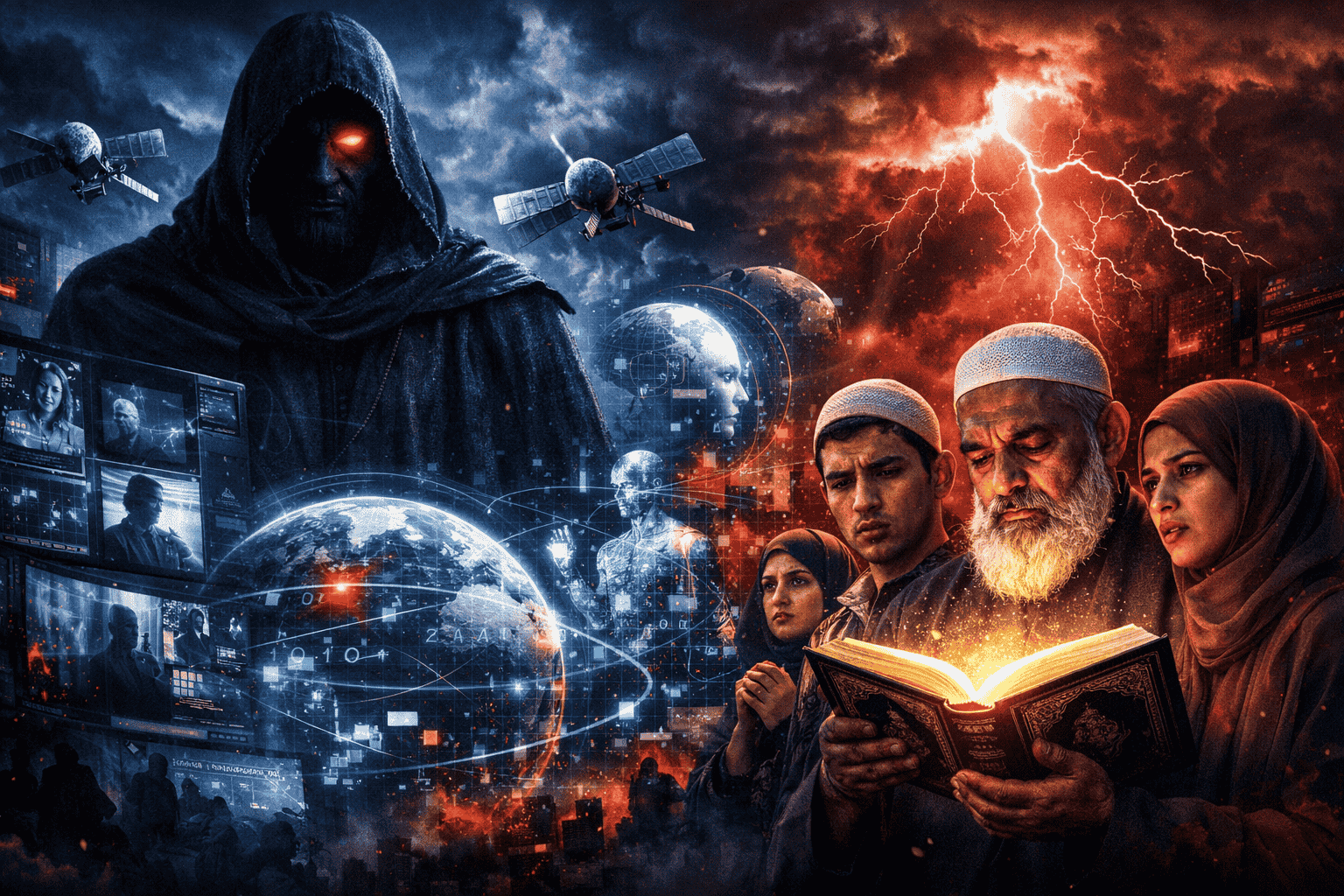
Throughout Islamic history, one of the most frightening figures associated with the end times is the Dajjal, often referred to as the False Messiah. His arrival is described in numerous prophetic traditions as one of the greatest trials humanity will ever face. Muslims believe that his deception will be so powerful that many people will be unable to distinguish truth from falsehood.
But an important question is increasingly discussed today:
Could modern technology make the deception of Dajjal even more powerful?
In an era dominated by artificial intelligence, social media, virtual reality, global surveillance, and advanced communication systems, the ability to influence billions of people instantly has become a reality.
Some scholars and thinkers wonder whether the tools of the modern digital age could unknowingly create the perfect environment for mass deception—the very type of deception that Islamic teachings warn about.
This article explores:
-
What Islamic texts say about the deception of Dajjal
-
How modern technology shapes human perception
-
Whether global digital systems could amplify deception
-
The possible relationship between technology and end-time trials
While technology itself is not evil, the way it is used can shape the world in profound ways.
Understanding these possibilities can help believers stay aware, strengthen faith, and remain vigilant in an increasingly complex world.
Table of Contents
ToggleUnderstanding the Dajjal in Islamic Teachings
Who is the Dajjal?
In Islamic eschatology, the Dajjal is described as a powerful deceiver who will appear before the Day of Judgment.
His name comes from the Arabic root meaning to deceive, cover the truth, or spread lies.
Prophetic traditions describe him as:
-
A one-eyed individual
-
Claiming divinity
-
Performing extraordinary feats
-
Misleading vast numbers of people
His influence will spread across the world rapidly, creating confusion and testing the faith of believers.
Many hadith describe the Dajjal as possessing abilities that appear supernatural, such as controlling resources, influencing weather, and presenting illusions of paradise and hell.
Because of these descriptions, scholars often emphasize that his deception will not rely only on words—but also powerful displays that convince people he has divine power.
The Nature of Dajjal’s Deception
The Greatest Trial in Human History
According to Islamic teachings, the trial of Dajjal will be unlike anything humanity has ever experienced.
The Prophet Muhammad warned believers repeatedly about this danger and encouraged Muslims to seek protection from it.
Several elements define Dajjal’s deception:
1. Manipulation of Reality
Dajjal will present things that appear real but are actually illusions.
For example:
-
What seems like paradise may actually be punishment
-
What appears like fire may actually be safety
This reversal of reality is a key theme in descriptions of Dajjal.
2. Control of Resources
Some narrations suggest that Dajjal will control food and wealth, forcing people to choose between survival and faith.
3. Global Influence
Unlike historical tyrants limited to specific regions, Dajjal’s influence will be global.
This raises a modern question: What tools could enable global influence so quickly?
This is where the discussion about technology becomes relevant.
The Rise of Modern Technology
A World Connected Like Never Before
In the past few decades, technological progress has transformed how humans communicate and understand reality.
Today the world is shaped by:
-
Artificial intelligence
-
Social media platforms
-
Global satellite networks
-
Virtual reality
-
Deepfake technology
-
Mass data surveillance
Information can now spread across the entire planet within seconds.
A single video can reach billions of people instantly.
This level of connectivity was unimaginable even fifty years ago.
But it also introduces a new challenge: distinguishing truth from manipulation.
Technology and the Power of Mass Influence
Social Media and Perception Control
Social media has become one of the most powerful tools for shaping public opinion.
Algorithms determine what billions of people see every day.
These systems can influence:
-
Political views
-
Cultural beliefs
-
Emotional reactions
-
Public narratives
In some cases, misinformation spreads faster than verified facts.
This demonstrates how easily human perception can be manipulated when powerful communication systems are involved.
If a deceiver had control over such systems, the potential for global influence would be enormous.
Artificial Intelligence and Deepfake Technology
When Seeing Is No Longer Believing
One of the most concerning developments in modern technology is deepfake media.
Artificial intelligence can now generate videos that look completely real, even when the events never happened.
These systems can create:
-
Fake speeches
-
Fabricated news events
-
Artificial human faces
-
Entirely synthetic videos
For centuries, people trusted visual evidence.
But today, technology makes it possible to manufacture convincing illusions.
This raises an unsettling possibility: in the future, people may struggle to distinguish truth from deception entirely.
Such a world could make humanity more vulnerable to manipulation on an unprecedented scale.
Virtual Reality and Artificial Worlds
Escaping Into Digital Illusions
Virtual reality is another technology rapidly advancing.
VR environments can simulate entire worlds where users feel fully immersed.
Some experts predict future systems will create experiences almost indistinguishable from real life.
This introduces philosophical questions:
-
What defines reality?
-
How easily can human perception be manipulated?
-
Could people become trapped in convincing illusions?
Islamic descriptions of Dajjal sometimes emphasize false realities and powerful illusions, making these technologies particularly interesting in the context of end-time discussions.
Global Surveillance and Control Systems
The Power of Data
Modern governments and corporations now collect vast amounts of data about individuals.
These systems can track:
-
Locations
-
Spending habits
-
Personal interests
-
Social networks
With enough data, powerful algorithms can predict and influence human behavior.
This raises concerns about centralized power and mass control.
In a world where technology can influence billions simultaneously, the potential for large-scale manipulation becomes more realistic than ever.
Could Technology Amplify Dajjal’s Deception?
A Theoretical Perspective
It is important to clarify that Islamic texts do not explicitly mention modern technology.
However, they do describe a level of deception and global influence that has never existed before.
Technology may provide tools that enable such influence.
For example:
-
Global media networks could spread propaganda instantly
-
Artificial intelligence could simulate miracles
-
Advanced illusions could manipulate perception
-
Digital control systems could restrict resources
While these possibilities remain speculative, they illustrate how modern systems could potentially magnify deception on a global scale.
The Psychological Dimension of Deception
Why Humans Are Vulnerable
Technology alone cannot deceive people.
Human psychology plays a critical role.
People tend to believe information that:
-
Confirms their existing beliefs
-
Comes from authoritative sources
-
Is repeated frequently
-
Appears visually convincing
Modern media ecosystems amplify these psychological tendencies.
This makes it easier for narratives—true or false—to spread rapidly.
Understanding these vulnerabilities is essential for resisting deception.
Protection From Dajjal in Islamic Teachings
Islam emphasizes spiritual preparation rather than technological speculation.
The Prophet Muhammad taught several ways to seek protection from the trial of Dajjal.
These include:
Strengthening Faith
Strong belief and knowledge are considered the greatest defenses against deception.
Reciting Surah Al-Kahf
Many hadith mention the importance of reciting Surah Al-Kahf, particularly on Fridays.
Seeking Protection in Prayer
Muslims are encouraged to ask Allah for protection from the trial of Dajjal.
Staying Connected to Truth
Islamic teachings emphasize knowledge, reflection, and sincere worship.
These principles help believers maintain clarity even in confusing times.
The Role of Faith in an Age of Technology
Technology itself is not inherently harmful.
It can be used for:
-
Education
-
Communication
-
Medical advancement
-
Social development
However, the ethical use of technology depends on human intention.
Faith traditions often remind believers that moral guidance must accompany technological progress.
Without ethical foundations, powerful tools can easily become instruments of manipulation.
Preparing for the Future
The rapid development of technology will continue to shape the world.
Artificial intelligence, biotechnology, and digital networks are evolving faster than many societies can adapt.
This makes spiritual awareness increasingly important.
Regardless of whether technology plays a role in end-time events, the core lesson remains the same:
Believers must remain vigilant, informed, and grounded in truth.
Conclusion
The concept of Dajjal’s deception remains one of the most powerful warnings in Islamic teachings.
While classical texts do not describe modern technology directly, the scale of deception they describe invites reflection in today’s digital age.
Modern technologies such as artificial intelligence, global media networks, and immersive virtual systems have dramatically expanded humanity’s ability to shape perception and influence reality.
These tools hold tremendous potential for both progress and manipulation.
Ultimately, the greatest protection against deception is not technological awareness alone—but faith, knowledge, and moral clarity.
As the world continues to evolve, these timeless principles remain essential for navigating an increasingly complex and interconnected future.
Leave a Reply