
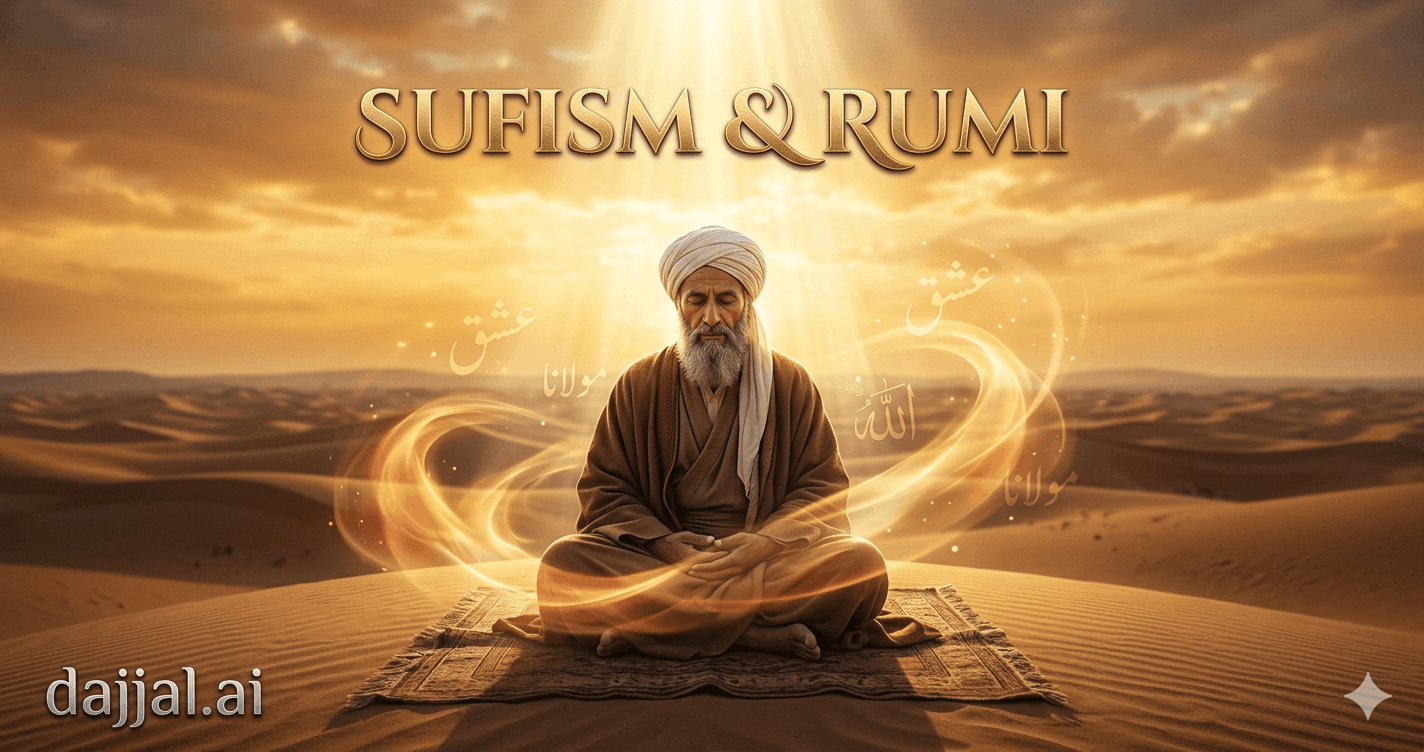
Sufism and Rumi: Love, Meditation & Self Discovery
The Silent Call Within
In a world filled with noise, distractions, and endless pursuit of material success, there remains a quiet longing within the human soul—a desire to understand who we truly are. This longing is not new. It has existed across centuries, cultures, and civilizations. And among those who explored this inner calling most deeply were the Sufis.
At the heart of Sufism lies a path of love, meditation, and self-discovery. And no name is more closely associated with this mystical journey than Jalāl ad-Dīn Muhammad Rūmī—widely known simply as Rumi.
His poetry continues to touch millions, not because of religious boundaries, but because it speaks directly to the human soul.
This article explores the deep relationship between Sufism and Rumi, focusing on how love, meditation, and self-exploration come together to transform the human experience.
What Is Sufism? A Path Beyond Religion
Sufism is often described as the mystical dimension of Islam, but in truth, it transcends labels. It is not just a religion—it is a way of experiencing the Divine.
At its core, Sufism is about:
- Purifying the heart
- Detaching from ego (nafs)
- Seeking unity with the Divine
- Experiencing unconditional love
Unlike rigid structures, Sufism invites personal experience. It emphasizes feeling over form, presence over ritual, and love over fear.
Sufis believe that God is not distant—but closer than one’s own breath.
Rumi: The Poet of Divine Love
Rumi was not just a poet—he was a spiritual revolutionary.
Born in the 13th century, he began as a respected scholar. But his life changed forever when he met his spiritual companion, Shams of Tabriz. This meeting ignited a deep transformation within him.
Rumi’s teachings revolve around:
- Love as the ultimate truth
- The annihilation of ego
- Inner awakening through presence
One of his most famous ideas is:
“What you seek is seeking you.”
This simple line reflects a profound spiritual reality—the answers we search for outside already exist within us.
The Role of Love in Sufism
Love as the Foundation of Everything
In Sufism, love is not just an emotion—it is the essence of existence.
Sufis believe that:
- The universe was created out of Divine love
- Every human soul carries a spark of that love
- The purpose of life is to return to that source
Rumi often describes love as a fire that burns away everything false.
Human Love vs Divine Love
Sufism distinguishes between two types of love:
- Worldly Love (Ishq-e-Majazi)
Temporary, attached to people or objects - Divine Love (Ishq-e-Haqiqi)
Eternal, connected to God
Interestingly, Sufis see worldly love as a doorway. Through human relationships, one can begin to understand deeper spiritual truths.
Meditation in Sufism: The Art of Inner Silence
While many associate meditation with Eastern traditions, Sufism has its own powerful forms of meditation.
Forms of Sufi Meditation
1. Dhikr (Remembrance)
Repeating the name of God to purify the heart and focus the mind.
2. Muraqaba (Silent Meditation)
A deep state of awareness where the seeker observes their inner self.
3. Sama (Spiritual Listening)
Music and poetry used to reach a higher spiritual state.
The famous Whirling Dervishes are a form of active meditation—symbolizing the soul’s journey toward the Divine.
Self-Discovery: The Journey Within
Sufism teaches that the greatest journey is not outward—but inward.
Knowing Yourself to Know God
A central idea in Sufism is:
“He who knows himself knows his Lord.”
Self-discovery involves:
- Understanding your ego
- Facing your fears
- Letting go of attachments
- Embracing your true nature
Rumi emphasizes that we are not incomplete—we are simply unaware of our completeness.
The Ego (Nafs): The Greatest Barrier
One of the biggest obstacles in Sufism is the nafs—the ego.
The ego:
- Seeks validation
- Creates fear and anxiety
- Separates us from truth
Sufi practices aim to soften and eventually dissolve the ego.
Rumi beautifully explains this:
“Why are you so busy with this or that or good or bad; pay attention to how things blend.”
When the ego dissolves, unity becomes visible.
The Connection Between Love, Meditation, and Self-Discovery
These three elements are not separate—they are deeply interconnected.
How They Work Together
- Meditation quiets the mind
- Love opens the heart
- Self-discovery reveals truth
Together, they create transformation.
Without meditation, love can become emotional attachment.
Without love, meditation becomes dry and mechanical.
Without self-discovery, both lose direction.
Sufism balances all three.
Rumi’s Teachings in Modern Life
Even in today’s digital age, Rumi’s wisdom feels more relevant than ever.
Why His Teachings Matter Today
Modern life is filled with:
- Stress and anxiety
- Disconnection
- Identity confusion
Rumi offers a different path:
- Slow down
- Turn inward
- Listen to your heart
Practical Applications
You don’t need to become a Sufi to benefit from these teachings.
You can start with:
- Daily silent reflection (5–10 minutes)
- Reading spiritual poetry
- Practicing gratitude
- Letting go of ego-driven reactions
The Power of Silence
In Sufism, silence is not empty—it is full.
Silence allows:
- Inner clarity
- Emotional healing
- Spiritual awareness
Rumi often speaks about silence as the language of God.
“Silence is the language of God, all else is poor translation.”
The Journey of Transformation
Sufism is not about instant enlightenment. It is a lifelong journey.
Stages often include:
- Awakening
- Struggle with ego
- Deep reflection
- Inner peace
- Union with the Divine
Each stage requires patience and sincerity.
Misconceptions About Sufism
Many misunderstand Sufism as:
- Escapism
- Purely poetic philosophy
- Detached from reality
But in truth, Sufism is deeply practical. It teaches how to live fully, consciously, and meaningfully.
Why People Are Drawn to Sufism Today
In a fast-paced, hyper-connected world, people are searching for:
- Meaning
- Peace
- Authenticity
Sufism offers all three—not through external success, but through internal transformation.
Final Reflection: Returning to the Self
At its core, Sufism is about returning—to your true self, to love, and ultimately to the Divine.
Rumi’s message is simple yet profound:
You are not lost.
You are simply disconnected from your essence.
And the journey back begins with:
- A moment of silence
- A spark of love
- A willingness to look within
Conclusion
The relationship between Sufism and Rumi reveals a powerful truth: love, meditation, and self-discovery are not separate paths—they are one unified journey.
In embracing this path, we don’t become something new.
We simply uncover what has always been within us.
Leave a Reply