
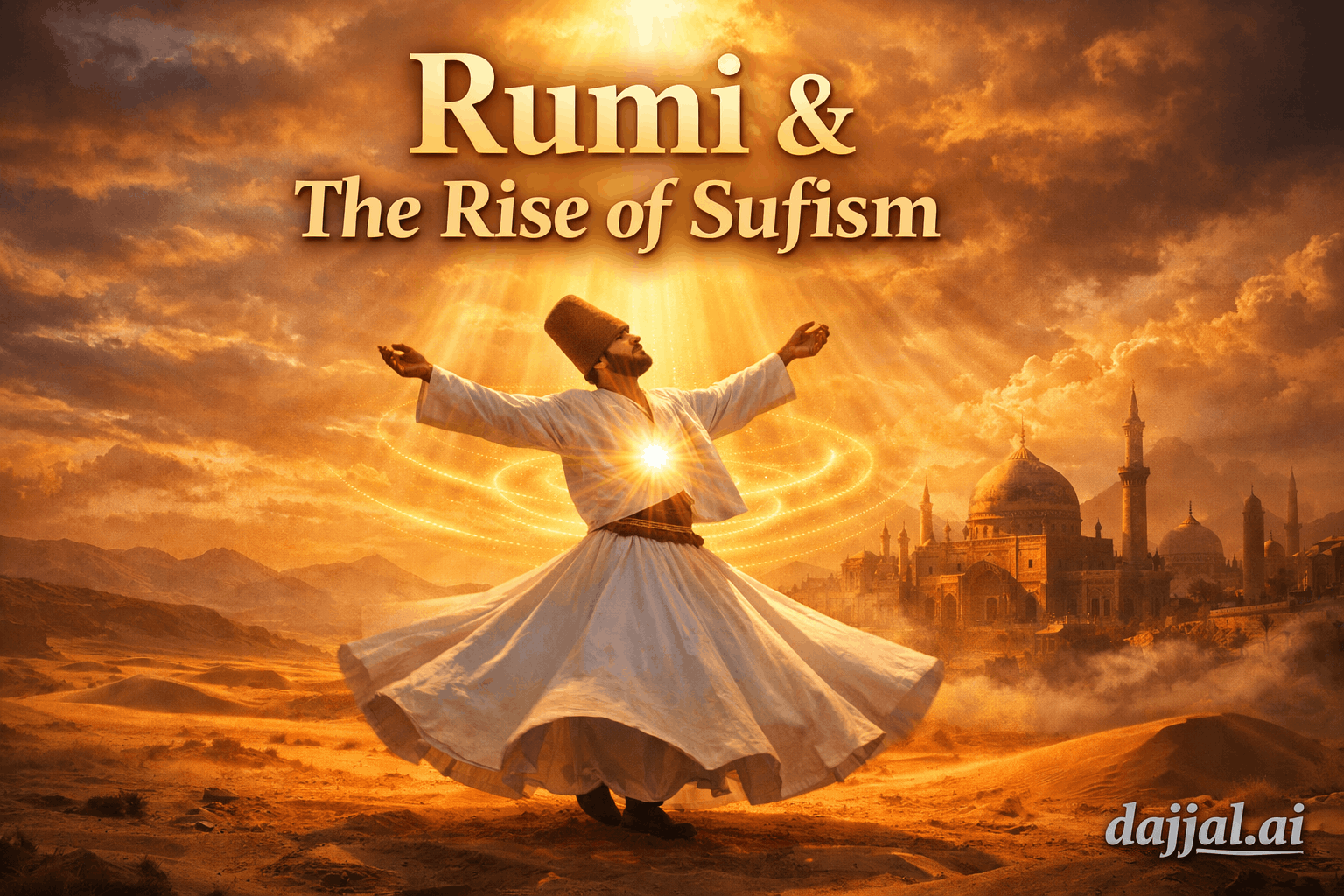
Why Sufism Became Popular Through Rumi Worldwide
Sufism, often described as the mystical dimension of Islam, has long been a path of inner transformation, love, and spiritual awakening. While its roots go back centuries, its global recognition and widespread appeal owe much to one extraordinary figure—Jalaluddin Rumi.
Today, Rumi’s poetry is quoted across cultures, religions, and continents. His words are shared on social media, printed in books, and even used in therapy and mindfulness practices. But why did Sufism, a deeply spiritual and often complex tradition, become so accessible and popular through Rumi?
This article explores the deeper reasons behind that phenomenon—looking at Rumi’s life, his message, and how his teachings transcended barriers to touch millions of hearts worldwide.
What Is Sufism?
Before understanding Rumi’s role, it’s important to grasp what Sufism actually is.
Sufism is not a separate religion but a spiritual path within Islam that focuses on inner purification, love for the Divine, and direct personal experience of God. Instead of rigid rituals alone, Sufism emphasizes:
- Love and devotion
- Self-discipline and humility
- Spiritual awareness
- Inner transformation
At its core, Sufism seeks to answer one profound question:
How can a human being truly connect with the Divine?
While traditional teachings can sometimes seem complex or philosophical, Rumi transformed these ideas into something simple, emotional, and deeply relatable.
Who Was Rumi?
Jalaluddin Rumi (1207–1273) was a Persian poet, Islamic scholar, and Sufi mystic. Born in present-day Afghanistan and later settling in Konya (modern-day Turkey), he lived during a time of social upheaval and spiritual searching.
Initially, Rumi was a respected religious teacher. However, his life changed dramatically after meeting a wandering mystic named Shams of Tabriz. This encounter ignited a deep spiritual transformation within him.
From that point on, Rumi began expressing his experiences through poetry—creating works that would eventually become some of the most beloved spiritual writings in history.
The Power of Rumi’s Poetry
1. Simplicity That Touches the Heart
One of the main reasons Sufism became popular through Rumi is the simplicity of his language.
Traditional spiritual texts can be difficult to understand. But Rumi spoke directly to the human heart. His poetry uses everyday imagery—love, longing, separation, and joy—to convey deep spiritual truths.
For example, instead of explaining complex theology, he might say:
“What you seek is seeking you.”
This kind of expression makes spirituality feel personal and immediate rather than distant or intellectual.
2. Universal Message Beyond Religion
Rumi’s message is deeply rooted in Islamic spirituality, yet it feels universal.
He rarely focuses on religious divisions. Instead, he emphasizes:
- Love as the ultimate path
- Unity of all existence
- The idea that truth is beyond labels
Because of this, people from all backgrounds—Muslim, Christian, Hindu, or even non-religious—can connect with his words.
This universality played a major role in spreading Sufism globally.
3. Love as the Central Theme
Perhaps the most powerful element in Rumi’s work is his focus on love.
But this is not ordinary love. It is divine love—a force that transforms the soul.
Rumi presents love as:
- A path to self-discovery
- A bridge between human and Divine
- A force that dissolves ego and separation
In a world often filled with conflict and division, this message resonates deeply.
How Rumi Made Sufism Accessible
1. Turning Philosophy into Emotion
Sufism contains deep philosophical ideas about existence, the soul, and God. These ideas can be abstract and difficult to grasp.
Rumi translated these concepts into emotional experiences.
Instead of explaining “unity with God” in technical terms, he described it as the longing of a lover for the beloved.
This shift—from intellect to emotion—made Sufism easier to understand and feel.
2. Storytelling and Metaphors
Rumi frequently used stories, parables, and metaphors.
Some common symbols in his poetry include:
- The reed flute (symbolizing separation from the source)
- The lover and beloved (symbolizing the soul and God)
- Light and darkness (symbolizing awareness and ignorance)
These symbols make complex ideas memorable and engaging.
3. The Whirling Dervish Tradition
Rumi also inspired a physical form of spiritual practice known as the “Whirling Dervish” dance.
This meditative movement symbolizes:
- The rotation of the universe
- The journey of the soul toward God
- Letting go of the ego
The visual beauty and symbolism of this practice helped attract global attention to Sufism.
The Role of Translation and Global Exposure
1. Translation into Western Languages
Rumi’s works were originally written in Persian. However, translations into English and other languages played a major role in his global popularity.
Although some translations simplify or reinterpret his original meaning, they have made his ideas accessible to millions.
Today, Rumi is often considered one of the best-selling poets in the English-speaking world.
2. Influence of Modern Spiritual Movements
Rumi’s teachings align closely with modern interests in:
- Mindfulness
- Meditation
- Personal growth
- Inner healing
As people search for meaning beyond material success, Rumi’s message feels relevant and timely.
3. Social Media and Digital Age
In today’s digital world, short, powerful quotes spread rapidly.
Rumi’s poetry, often brief yet profound, fits perfectly into this format. His lines are widely shared on:
- Blogs and websites
This has significantly increased his reach among younger generations.
Emotional and Psychological Appeal
1. Healing Through Words
Many people turn to Rumi during difficult times.
His poetry offers comfort by addressing:
- Pain and loss
- Loneliness
- Confusion
- Spiritual emptiness
Rather than denying suffering, Rumi embraces it as part of transformation.
2. Encouraging Self-Discovery
Rumi encourages readers to look within.
He teaches that:
- The answers we seek are already inside us
- True change begins internally
- The soul’s journey is personal and unique
This message resonates strongly in today’s self-development culture.
3. Breaking the Ego
A central theme in Sufism is the dissolution of the ego.
Rumi explains this idea in a gentle and poetic way, making it easier to understand.
He shows that letting go of ego leads to:
- Inner peace
- Freedom
- Deeper connection with others
Cultural Impact of Rumi
1. Influence on Literature and Art
Rumi’s work has influenced:
- Modern poetry
- Music
- Visual arts
- Films and storytelling
Artists often draw inspiration from his themes of love and spirituality.
2. Presence in Popular Culture
Today, Rumi’s quotes appear in:
- Books and journals
- Therapy sessions
- Motivational speeches
- Online content
His words have become part of everyday language for many people.
3. Bridging East and West
Rumi serves as a bridge between Eastern spirituality and Western audiences.
His teachings help people appreciate Islamic mysticism without feeling overwhelmed by unfamiliar traditions.
Criticism and Misinterpretation
While Rumi’s popularity is a positive development, it also comes with challenges.
1. Loss of Original Context
Some modern interpretations remove the Islamic foundation of his teachings.
This can lead to a misunderstanding of Sufism’s roots.
2. Oversimplification
Short quotes often lack the depth of his original work.
While they are inspiring, they may not fully capture his philosophy.
3. Commercialization
Rumi’s words are sometimes used for commercial purposes, losing their spiritual essence.
Despite these issues, his core message continues to inspire genuine seekers.
Why Rumi Still Matters Today
In a fast-paced and often disconnected world, Rumi’s teachings offer something rare:
- A sense of meaning
- Emotional depth
- Spiritual connection
He reminds us that:
- Love is more powerful than fear
- Inner peace is possible
- The journey toward truth is universal
Conclusion
Sufism became globally popular through Rumi not just because of his poetry, but because of how he transformed spirituality into something deeply human.
He took complex ideas and made them simple.
He took abstract concepts and made them emotional.
He took a traditional path and made it universal.
Rumi’s legacy continues to grow because his message speaks to something timeless within us—the desire for love, connection, and meaning.
And perhaps that is why, even after centuries, his words still feel alive.

Leave a Reply