
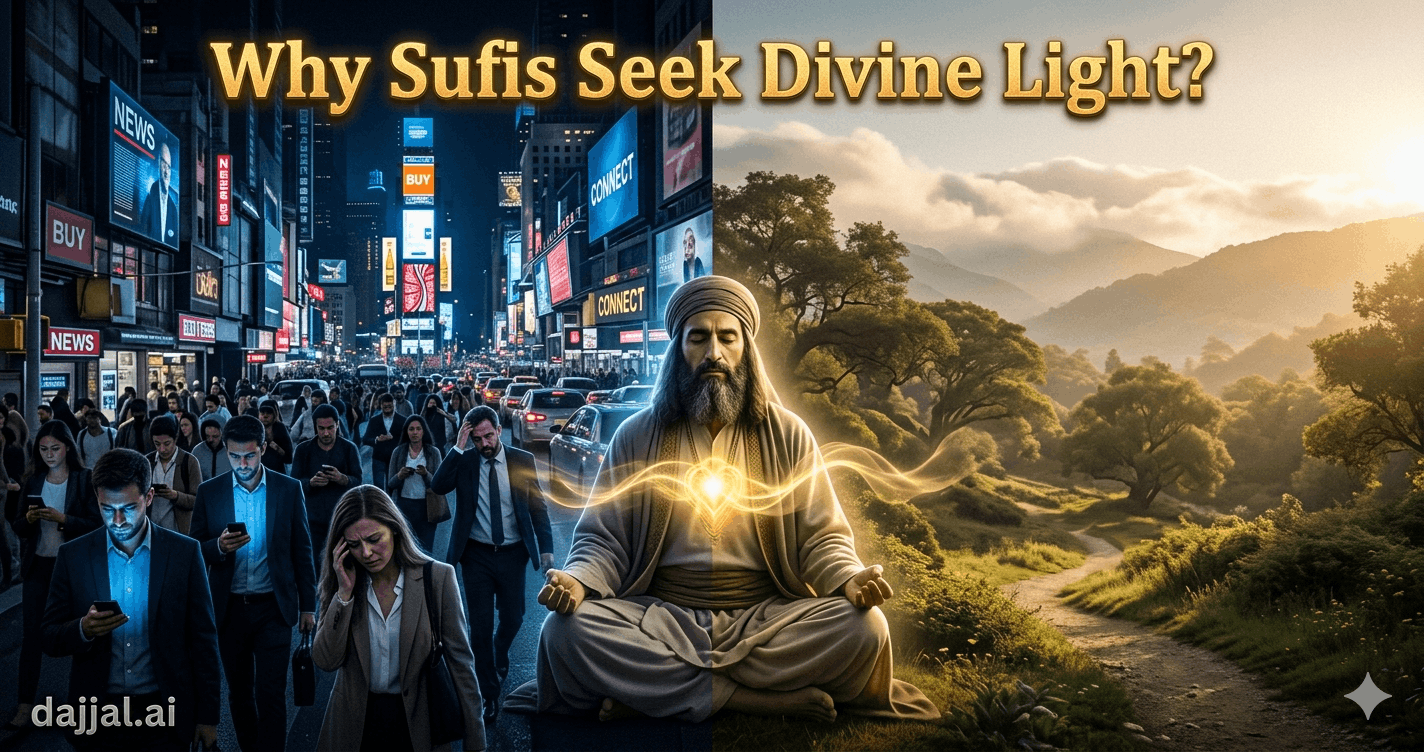
Sufi Meditation: Why Mystics Seek Divine Light Beyond World
The Silent Call Beyond the World
There is something deeply mysterious about those who walk away from the noise of the world—not out of despair, but out of a quiet longing. Sufi mystics, known for their deep spiritual insight, have for centuries chosen a path that seems paradoxical to many: they step away from worldly attachments not to escape life, but to truly understand it.
At the heart of this journey lies meditation, or what Sufis often describe as zikr (remembrance) and muraqaba (spiritual contemplation). These practices are not just rituals; they are gateways—subtle doorways leading from the visible world into the unseen realm of نور (Divine Light).
But why do Sufi seekers feel compelled to leave behind comfort, status, and even relationships? What is this “light” they are searching for? And what can modern individuals learn from their journey?
This article explores the profound relationship between Sufi meditation and the quest for divine light—uncovering truths that are as relevant today as they were centuries ago.
The Essence of Sufism: Beyond Religion, Into Experience
Sufism is often misunderstood as merely a branch of Islam, but those who have walked its path describe it differently. It is less about doctrine and more about direct experience.
Sufis believe that truth cannot be fully grasped through logic alone. Instead, it must be felt, lived, and realized within the heart.
Unlike conventional approaches to spirituality that rely heavily on external practices, Sufism turns inward. It asks a simple but profound question:
Who are you when everything else is taken away?
The journey of a Sufi begins with this inquiry—and meditation becomes the tool through which the answer slowly reveals itself.
What Is Sufi Meditation (Muraqaba)?
Sufi meditation, or muraqaba, is often described as watchfulness—a deep awareness of the Divine presence.
Unlike common meditation techniques that focus on breathing or emptying the mind, Sufi meditation emphasizes:
- Awareness of God’s presence
- Soft repetition of sacred names (zikr)
- Inner stillness combined with emotional surrender
It is not about controlling thoughts but about transcending them.
In muraqaba, the seeker sits in silence, allowing the heart to become receptive. Over time, this silence begins to feel alive—almost luminous.
Why Do Sufi Mystics Leave the World?
1. The Illusion of Material Reality
Sufis believe that the world we see is not the ultimate reality—it is a reflection, a shadow.
We chase wealth, recognition, and pleasure, thinking they will fulfill us. Yet, even after achieving these things, many feel an unexplainable emptiness.
Sufi mystics recognize this early. They understand that:
- Material success is temporary
- Emotional satisfaction is unstable
- Identity based on external factors is fragile
So, they turn inward—not out of rejection, but out of clarity.
2. The Hunger of the Soul
Just as the body needs food, the soul has its own hunger. But this hunger cannot be satisfied by anything physical.
It longs for connection—something deeper than relationships, beyond achievements.
Sufis describe this longing as a pull toward the Divine, a silent call that becomes impossible to ignore.
Meditation becomes the way to respond to this call.
3. The Search for Divine Light (Noor)
In Sufi philosophy, Noor (Divine Light) represents truth, awareness, and ultimate reality.
It is not physical light, but a state of consciousness.
Through meditation, Sufis believe that:
- The heart becomes purified
- The ego dissolves
- Inner perception awakens
Eventually, the seeker begins to experience moments of clarity—brief glimpses of this light.
These moments are transformative. Once felt, they change everything.
The Role of the Ego: The Biggest Barrier
One of the central teachings in Sufism is the concept of the ego (nafs).
The ego constantly seeks control, validation, and dominance. It creates:
- Fear
- Desire
- Attachment
- Identity illusions
Sufi meditation works to gradually weaken the ego—not by force, but through awareness.
As the ego loses its grip, something remarkable happens:
The seeker begins to experience freedom—not from the world, but within it.
Stages of the Sufi Journey
The path of a Sufi is often described in stages. While different traditions name them differently, the essence remains similar.
1. Awakening
A realization that the current way of living is incomplete.
2. Seeking
A conscious effort to explore spirituality through meditation and reflection.
3. Purification
Letting go of ego-driven desires and negative patterns.
4. Illumination
Experiencing moments of deep inner clarity and peace.
5. Union
A state where the distinction between self and Divine begins to dissolve.
These stages are not linear. The seeker may move back and forth, struggling and growing at the same time.
The Power of Silence in Sufi Meditation
Silence plays a crucial role in Sufi practice.
In a world filled with constant noise—notifications, conversations, distractions—silence becomes rare.
But in silence:
- Thoughts slow down
- Emotions surface
- Awareness deepens
Sufis believe that God speaks in silence.
Not through words, but through feelings, insights, and subtle shifts in perception.
Misconceptions About Sufi Mystics
Many people believe that Sufis:
- Reject the world completely
- Live in isolation
- Avoid responsibilities
This is not entirely true.
True Sufism does not require abandoning life. Instead, it teaches:
Live in the world, but do not let the world live inside you.
Some Sufis do choose solitude, but many remain actively engaged in society—working, teaching, and helping others.
Their detachment is internal, not external.
Sufi Meditation vs Modern Mindfulness
At first glance, Sufi meditation may seem similar to modern mindfulness practices. However, there are key differences.
| Aspect | Sufi Meditation | Mindfulness |
|---|---|---|
| Focus | Divine connection | Present moment awareness |
| Goal | Spiritual union | Mental clarity |
| Method | Zikr + contemplation | Breath + observation |
| Depth | Emotional & spiritual | Psychological |
While mindfulness helps reduce stress, Sufi meditation aims for transformation of the self.
Can Modern People Follow the Sufi Path?
The modern world is fast, demanding, and often overwhelming. Yet, the principles of Sufism are more relevant than ever.
You don’t need to become a mystic or leave your life behind.
You can start with simple practices:
- Spend 10 minutes daily in silence
- Reflect on your thoughts and emotions
- Practice gratitude
- Let go of unnecessary attachments
Even small steps can create significant changes.
The Inner Transformation: What Really Changes?
People who practice Sufi meditation over time often experience:
- Increased inner peace
- Reduced anxiety
- Greater emotional balance
- Deeper sense of purpose
- Enhanced compassion
But the most important change is subtle:
A shift from seeking happiness outside to discovering it within.
Stories of Sufi Wisdom
Sufi teachings are often shared through stories.
One famous teaching says:
A man searched for a treasure across the world, only to discover it buried beneath his own home.
This story reflects a central truth:
What we seek externally already exists within us.
Meditation simply helps us uncover it.
The Balance Between World and Spirit
Sufism does not ask you to reject the world entirely.
Instead, it teaches balance.
You can:
- Work and still be spiritually aware
- Love and still remain unattached
- Live fully without losing yourself
This balance is the true art of Sufi living.
Why This Path Feels Difficult
If this journey is so beautiful, why doesn’t everyone follow it?
Because it requires:
- Patience
- Discipline
- Letting go of comfort
- Facing inner fears
The ego resists change. The mind prefers familiarity.
But those who persist discover something far greater than comfort:
truth.
Final Reflection: The Journey Toward Light
Sufi mystics do not leave the world because they hate it.
They step away because they see beyond it.
They are not escaping reality—they are seeking a deeper one.
Meditation becomes their bridge, silence their guide, and نور their destination.
In a world that constantly pulls us outward, their path reminds us of something essential:
The deepest answers are not found outside—they are discovered within.

Leave a Reply